



The evaluation mission of CEDER provides support to U-M central administration, campus units, individual researchers, and community-based educators for evaluation or technical assistance related to education programs and research. Related to the evaluation strand is a research strand focused on conducting expert research on education practice at multiple levels and in multiple sites. Marsal School faculty members already engage in multiple forms of practice-based education research.
Evaluation services
Clients can partner with CEDER as a part of the grant process, after being awarded a grant or through a fee-for-service arrangement. CEDER’s evaluation services include:
- Full-scale evaluation design and administration
- Proposal writing and evaluation plan development
- Process and outcome evaluation design
- Logic modeling and theory of change development
- IRB application support
- Survey, interview, and focus group protocol design
- Qualitative and quantitative data analysis
- Dashboard development
- Report writing and data visualization
Evaluation process
Every project begins with a question worth asking. Sometimes it starts as a promising idea in search of funding. Sometimes it is a newly awarded grant, ready to move from proposal to practice. And sometimes it is an ongoing program whose leaders want to better understand what is working, what could be improved, and what impact the work is making.
In the earliest stages, we help teams give shape to their ideas. We work with partners to develop logic models and theories of change, design evaluation plans, and craft proposal language that shows funders not only what a project hopes to accomplish, but how its progress and outcomes will be understood.
Once a project is underway, we help build the structures needed to learn from the work. That may include designing process and outcome evaluations, supporting IRB applications, developing surveys and interview protocols, collecting and analyzing qualitative and quantitative data, and translating findings into clear reports, visualizations, and dashboards.
Whatever the scope of a partnership, our goal is to help clients generate rigorous, actionable evidence. Evaluation at CEDER is not simply about documenting results. It is about helping people learn, improve, tell the story of their work, and make informed decisions that strengthen the communities they serve.
Featured Evaluation Projects


Workshops
Workshop content may be modified to fit the audience and time frame. Please contact CEDER with questions and for scheduling a workshop for your team.
Logic Model Preparation
Evaluation Specialists from CEDER are available to provide a half-day workshop on the use and development of logic models.
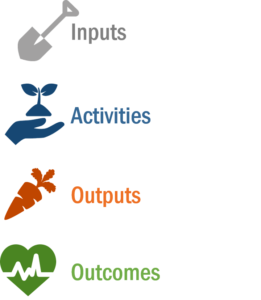
The workshop will include information on how to create and use logic models in an evaluation process. Participants will be asked to create a logic model using a current project or program they are currently working on. A pre-workshop survey will be distributed to gather information on participant background and need.
Learning Goals
After attending this workshop, participants will be able to
- describe each component of a logic model;
- create a logic model for a program;
- identify ways of using logic models in their programs.
Data Intake and Cleaning Workshop
After completing this workshop, the participant will
- have experience with importing excel, text, and .csv files into Stata. The participant will also know how to troubleshoot importing data into Stata;
- learn a process for systematically intaking and cleaning data such that the original data is preserved, and the data is ready for analysis in Stata;
- be able to clean numerical, categorical, and string data in Stata;
- have experience with handling missing and ambiguous values in original data sources;
- have experience with setting up a .do file structure that encourages heavily annotated code;
- have experience with a .do file tracking system that allows a researcher to follow their code from data intake, cleaning, and analysis.
Connect with us
Our Services
Campus and Mailing Address
University of Michigan – School of Education
Center for Education Design, Evaluation, and Research
610 East University Ave, Suite 1033
Ann Arbor, MI 48109
Contact Information
(734) 615-5028
[email protected]