


Teaching Literacy Through the Disciplines
How the Marsal Family School of Education prepares secondary educators to teach literacy skills that students need for learning in the disciplines

In the spring 2025 issue of Marsal Educator, we unpacked the "full science of reading" and shared the ways in which students in our Educator Preparation Program are trained to teach literacy in the elementary grades. The second part of our series explores how teaching interns who will lead middle and high school classrooms are prepared to continue teaching literacy in the upper grades.
"There is a commonplace assumption that there is a phase of development where one learns to read, and then another phase where one reads to learn," says Dean Elizabeth Birr Moje. "But actually, people are always learning to read and always reading to learn."
A former high school history, biology, and drama teacher, Moje's research examines young people's culture, identity, and literacy learning in and out of school in Detroit. At Marsal Education, Moje teaches undergraduate and graduate courses in secondary and adolescent literacy, cultural theory, and research methods. She is a leading scholar in the field of disciplinary literacy.

"When we focus only on learning the foundational skills necessary to decode and recognize words at a very young age, and we're not teaching kids to read for meaning, we're doing them a disservice for later years," explains Moje. "Simultaneously, when we are not focusing on learning to read at upper grades, we're also doing kids a disservice." As students progress from elementary grades into departmentalized instruction—when their science class is taught by a science teacher who has specific training in the sciences—the discourse in the classroom changes. "It's not just the words themselves and the meaning of the words," says Moje, "it's the actual discourse—the way people talk, the assumptions they bring to their speech, the way their speech or their reading or their writing is tied to a practice that they engage in on a regular basis."
For instance, in a science class, the phrase "gathering evidence" might describe the process of recording results from an experiment or observation, whereas in a literature class, "gathering evidence" might mean citing passages of text to support an argument in an analytic essay. These are both examples of a particular way of doing things in a discipline. But a student doesn't necessarily have this knowledge—or know how to differentiate between disciplinary contexts—before entering the teacher's classroom. If not taught how to read in different disciplines, students may struggle.
In many cases, when older children struggle with reading or writing at the upper grades, teachers and parents assume that the learners are struggling with word-level skills because most people think that reading and writing are only about knowing words. But literacy is about understanding different "ways with words" or discourses. Assessments such as the National Assessment of Education Progress (NAEP), for example, demonstrate that the majority of our nation's children can read (and write) words. However, to be considered "proficient" in reading, readers must grapple with complex comprehension tasks that require the ability to draw inferences across long passages of text, to compare texts, and to bring relevant knowledge to texts. Indeed, one of the most interesting conundrums of the literacy process is that learning new knowledge from a text depends on a reader's skill in bringing existing knowledge to that text. Literacy skill both depends on and produces knowledge.
It is also important for readers and writers to set purposes for reading and writing. People read for different reasons and in different ways, depending on the context in which they are reading. Reading to solve a problem requires different skills and strategies than reading for personal enjoyment. The different disciplines that students encounter throughout school present unique contexts and purposes for reading.
"Disciplinary literacy is about teaching children how to make sense of texts and how to produce texts according to different disciplinary demands," says Moje. Although students don't experience departmentalized instruction until middle and high school, she emphasizes that disciplinary literacy can begin in the earliest grades.
"The sooner we're introducing different kinds of disciplinary discourse to kids, the sooner they will learn them. Because what we know from learning theory is that we don't have to wait for development for people to learn things. In fact, learning and development are interactive. They go together."
It is one thing to know about the processes by which humans learn to read and write. It is another to teach 25 to 30 other humans—whether young or old—to read and write. One of the Marsal School's strengths lies in the work faculty do to help teachers learn to teach literacy across the age span, as well as the work they do to support practicing teachers to hone their practice once in the classroom as the teacher of record.
In 2015, Marsal School Professor Nell Duke was approached by the Michigan Association of Intermediate School Administrators (MAISA) to develop a set of research-supported practices for in-service teachers leading literacy instruction in preschool through third grade. Duke was joined in the work by Professor Tanya Wright and a team of graduate students, creating a set of practices that ultimately became known as the Literacy Essentials.
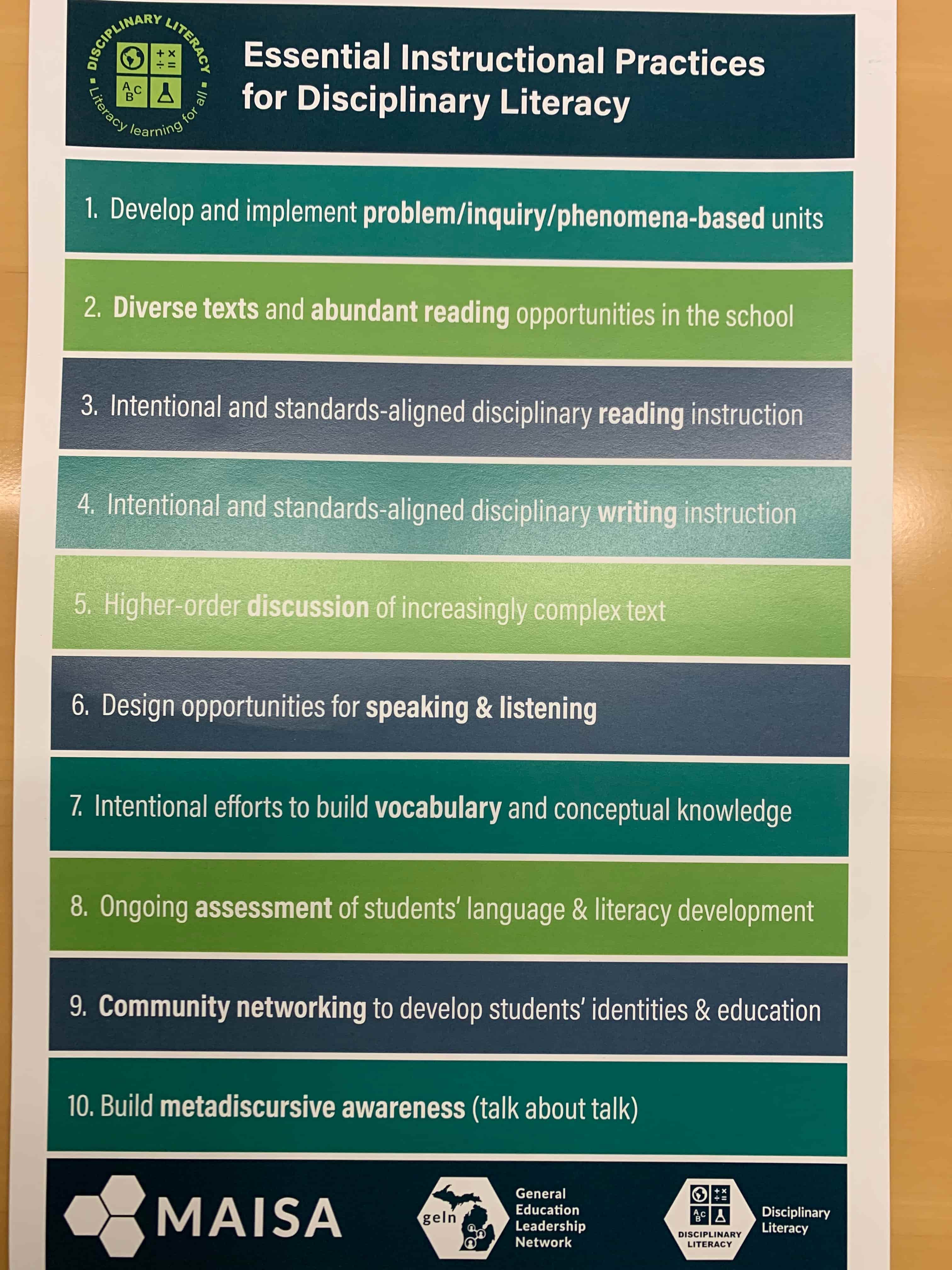
Because literacy instruction doesn't end with completion of the early grades, partners at the state level and within Marsal Education soon recognized the need to create aligned instructional literacy practices for all grade levels. Along with colleagues across the state, graduate students, and U-M researchers, Professor Annemarie Sullivan Palincsar developed the essential literacy practices for educators in grades four and five. Moje was joined by U-M colleagues Drs. Darin Stockdill and Michelle Nguyen Kwok, as well as statewide collaborators who worked as a collective to think about literacy practices in the four major disciplines—English, mathematics, science, and social studies (more recent work has added practices for elective classes in a document called Beyond the Core). Together, they established 10 essential practices for disciplinary literacy in secondary classrooms.
"We created a draft version, and then the practices were presented to a working group convened by MAISA that included intermediate school district (ISD) consultants from across the state, and content area groups at the secondary level to undergo an intensive, years-long revision process," says Stockdill. Today, the full suite of essential literacy practices—from birth to age three through grade 12—are available on LiteracyEssentials.org.
The disciplinary literacy practices are expected to be implemented at the course and unit level. They help teachers think about what they should be doing to support young people in learning literacy practices in different disciplinary domains. As students continue to develop their skills through middle and high school, literacy instruction must also help them meet increasingly complex subject area demands. These demands include developing the critical thinking, problem-solving, and communication skills specific to each discipline.
"Disciplinary literacy is not merely teaching vocabulary. It's actually about so much more—it's about ways of knowing, ways of doing things, and at its core, disciplinary literacy is about inquiry," says Moje. In the disciplines, people ask questions, pose problems, and puzzle our existence in the world. "Once we engage in those practices, then we're teaching students how to read, how to write, how to listen, and how to communicate in the ways that match those of the discipline."
For secondary teaching interns preparing to lead middle and high school classrooms, literacy training has traditionally followed the same approach, whether a student planned to teach English language arts or biology or music.
"When I was a secondary teacher candidate, all the content areas were lumped into one classroom, and you learned a set of universal strategies to help students become more strategic readers," recalls Stockdill. "There was a lot of focus on reading, and some focus on writing, but it was sort of content-neutral."
By contrast, the Marsal School's preparation of secondary teachers is unique in that students are taught in cohorts organized by content area. This allows them to dive deeper into their respective subject, opening up a rich opportunity to explore literacy within their discipline and how to teach it.
"A mathematician defines terms very differently than a literary scholar does. In math, words tend to have precise, consistent definitions. In literature, a word can take on connotative meanings and can have multiple meanings—it's a much more interpretive process," says Stockdill. Each discipline has language norms and tools that differentiate it from others. "The idea of disciplinary literacy is that academic disciplines have their own cultural practices, and there is value in apprenticing young people into these practices so that they become more critical consumers and producers of information."
All teaching interns at the Marsal School take Education 402: Reading and Writing in Content Areas within their chosen discipline. The course offers an introduction to the processes of reading and writing development, emphasizing methods and materials for teaching literacy skills. Through a series of hands-on projects that are tied to experiences in their field placements, teaching interns are taught to think about school as a context for literacy learning.
"In 402, we start by thinking about literacy and trying to expand our students' notions of all that literacy encompasses," says Stockdill. "It's much more than reading. It's about communication, it's writing, it's engaging with multimedia texts. Next, we work on deconstructing the notion of disciplinary literacy in a broad sense. Then students take deeper dives into their content areas, identifying what literacy practices look like in their discipline. They examine the language, the reading practices, and the writing practices through engaged activities that they might then adapt for their own students."
"The 402 course literally changed my life," says Dr. Bridget Maher, an associate research scientist at the Marsal School. Moje taught the class Maher took when she was an undergraduate at the Marsal School studying to become a high school English, history, and social science teacher. She went on to teach, attend graduate school, and return to Marsal to pursue doctoral studies focusing on disciplinary literacy. Today, she teaches 402 to current Marsal School students and her research focuses on teaching and learning across domains and disciplines of school and how to support early teachers in this work.
"At the beginning of the semester, when I tell my students the class changed my life, they don't believe me," says Maher. But by the end of the term, she says they understand how one "can get hooked on this theory, the way that we understand literacy and supporting all learners, why this is a framework to better understand some of the challenges of teaching literacy—and how we address those challenges and literacy achievement."
Maher still remembers the profound impact a project called "Student Study" had on her when she was taking 402 herself.
"You sat with one young person and really got to know them. You interviewed them, gave them a questionnaire, had them read aloud to you, listened to their reading, asked them questions about what they were reading, and interacted with them," says Maher. "It was both inspirational and also incredibly practical to sit with one kid and not be overwhelmed by teaching 35 kids five times a day in a secondary classroom." The outcome of the student study is a deep understanding of one learner. Following this experience, the preservice teachers talk together in 402 about how to extrapolate and plan for the larger and multiple classes in secondary contexts.
Although it has evolved over the years, the student study is still a cornerstone of the 402 course. The project allows teaching interns to spend one-on-one time with a student, getting to understand their background, motivations, and interests, as well as their strengths and challenges when it comes to literacy. As a teacher, Maher says, you don't really know why a student might be struggling in class unless you get to know the student. Once you have a relationship established, it's easier to discern if they would connect better literacy-wise with different reading material, or perhaps there is a different way to capture their interest in the course content.
Contrary to what Maher was told ahead of time, the student she worked with in the student study was motivated. He could point out how the assignments in his history class weren't that interesting or very well thought out. He loved gaming, and had memorized the many procedures and routines involved in playing Dungeons and Dragons. Because of this, she knew he had strong comprehension skills. In fact, he was reading incredibly complex texts. Understanding how the student thought about gaming—a topic he was passionate about—gave Maher a way to leverage the skills he was already using when he played D&D by applying them to the way texts functioned in his history class.
The practice motivated Maher "to understand how you meet kids where they are so that they get to be not just participants, but shapers of those disciplines. If you really want kids to have a sense of agency, I don't know how you do that without knowing them well or without asking them to think really critically about the discipline or knowledge building or the way that people communicate that knowledge in the world. Disciplinary literacy lets kids—in the secondary classroom especially—have the sense that they're allowed to ask big questions, and look for answers."
After thinking about student identities in the student study project, teaching interns in 402 move on to thinking about text as a construct. The notion of what constitutes a text goes far beyond a textbook. "We have a very broad conceptualization of text as information sources that are encoded in some way and that need to be read or interpreted through disciplinary practices," says Stockdill.
The text study asks 402 students to consider what they would need to do to help their secondary students access the material at hand. "What are the challenges of this text? What might the discipline ask about these texts? If I'm a historian, and I'm looking at primary documents, what might I be interested in considering? Or what other documents do I need in order to understand or interpret this contextualization? That's what disciplinary literacy has started to name," says Maher. "What are the practices, the skills, or the thinking patterns that disciplinarians bring to a text? Disciplinary literacy reveals these methods rather than letting them be tacit."
Education 402 students get lesson planning and instructional design experience by creating an assignment that they would give to students in their classroom. In this project, Maher pushes them to think about what habits of mind the assignment will encourage, or what literacy practices it will help expand. The students also put together text sets that they share with each other and have access to once they are in their own classrooms.
Teaching interns also do a school study at their field placement location. In this project, they ask themselves questions about the populations that are represented at the school; what it feels like when they are in the school; whether it feels like a school they've experienced in their own past, or not; how they make sense of that difference; and whether or not they notice any bias that comes up around that difference. They also spend time noticing various aspects of literacy in the school: how many books are present; what the library feels like; how accessible the library books are; and whether kids get copies of books to read in class or if they are reading excerpts.
In addition to the focused work within their discipline cohort, each November the secondary education program calls together its students across all content areas for Grand Rounds. Each year, the conversational forum featuring faculty and veteran teachers takes up a new problem of practice. Topics of discussion have included ways to use parent or caregiver conferences as an opportunity to learn more about a student, how to hold office hours in a high school setting, how to create writers' workshops, and how to account for learner variability. Students come away from Grand Rounds with a toolkit of various approaches to enact disciplinary literacy in their own classrooms.
The Marsal School has long employed the approaches identified in the Literacy Essentials to prepare teaching interns, but in recent years, the work of disciplinary literacy has been taken up far beyond its halls. Stockdill and Moje continue to collaborate with a statewide task force to support the implementation of the Essential Instructional Practices for Disciplinary Literacy
by secondary teachers in Michigan. And, notably, the Michigan Department of Education has drawn on the Literacy Essentials to rewrite the standards for the reading/literacy course in secondary teacher preparation programs. The fall 2026 term will be the first in which all teacher preparation programs in Michigan will be expected to begin teaching to these new standards.
Following the notion that students learn to read, then read to learn, some secondary teachers have argued that they are not, in fact, teachers of reading. They have specialized knowledge in physics, in engineering, or in math—literacy, they might say, is the responsibility of second and third grade teachers, or that of the English teacher. "That is what we have tried to change with disciplinary literacy," says Moje. "This isn't about being a teacher of reading, this is about you teaching math. But to teach math, you must teach kids both the oral and written language of mathematics."
"We try to help people see that this approach honors their content area," says Stockdill, "and hopefully it helps them live into teaching their discipline more effectively."
MORE FROM Fall 2025