


Learning is the Through Line for Fatema Haque
The CSHPE alumna embodies this issue’s theme of learning for meaning, learning for joy, and learning for life

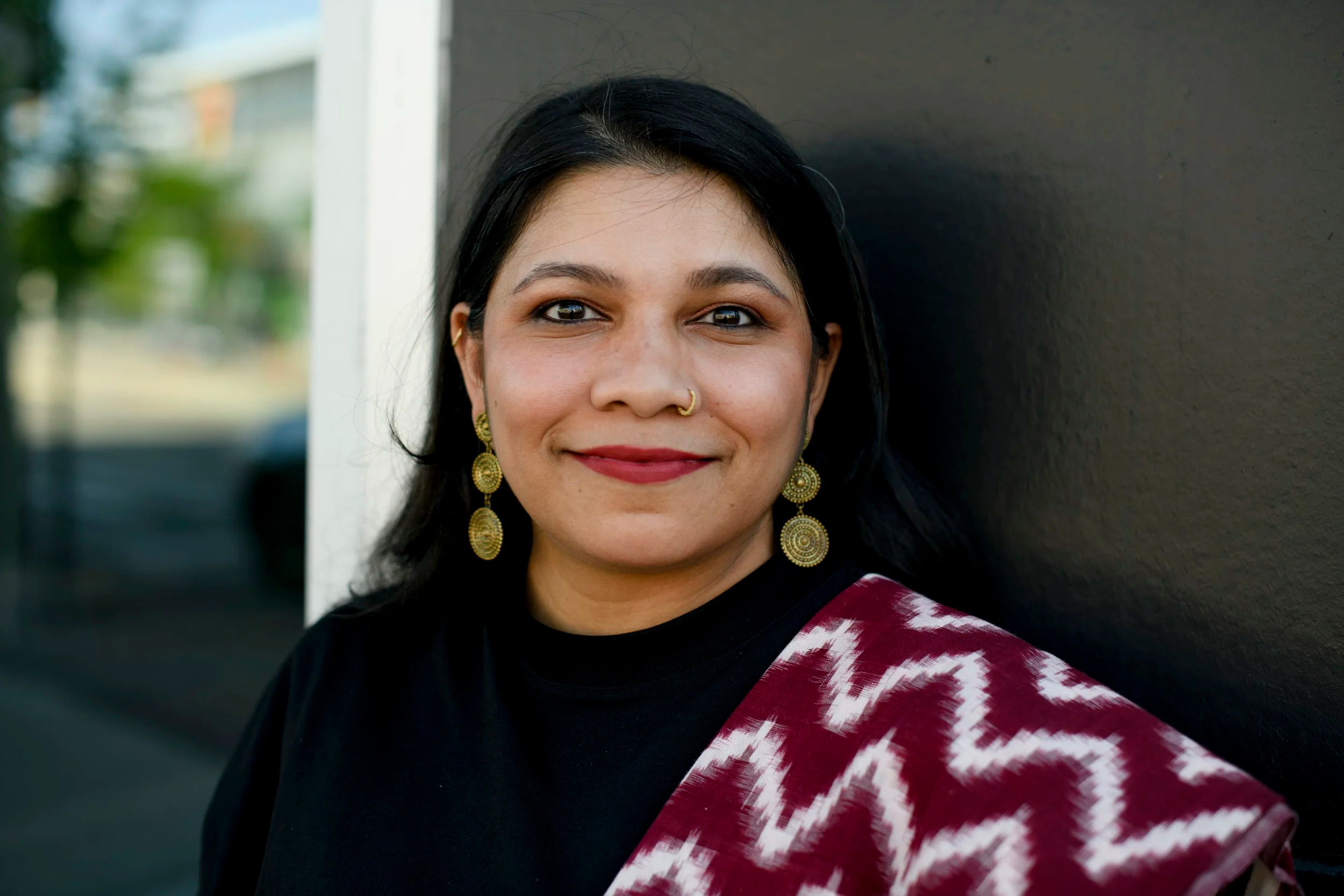
Fatema Haque (AB '09, AM '15) began her career working as a teacher and then as dean of students at the Asian University for Women in Chittagong, Bangladesh. There, she helped international students who hailed from countries across Asia prepare to study liberal arts in American-style school settings. During that time, she became fascinated by the field of higher education. After several years, she chose to return to the University of Michigan, her alma mater, to pursue a master's degree in CSHPE's management and organization concentration.
Learning for Meaning
As a CSHPE student, Haque particularly enjoyed learning about—and visiting—minority-serving institutions, including HBCUs and tribal colleges. She also highly valued her internship experience with the U-M Center for Engaged Academic Learning, where she was able to work on curriculum design. This led to an opportunity to design curricula for Michigan Medicine, as the Medical School moved clinical experience earlier on in students' education and integrated basic sciences into the clinical portion of their training.
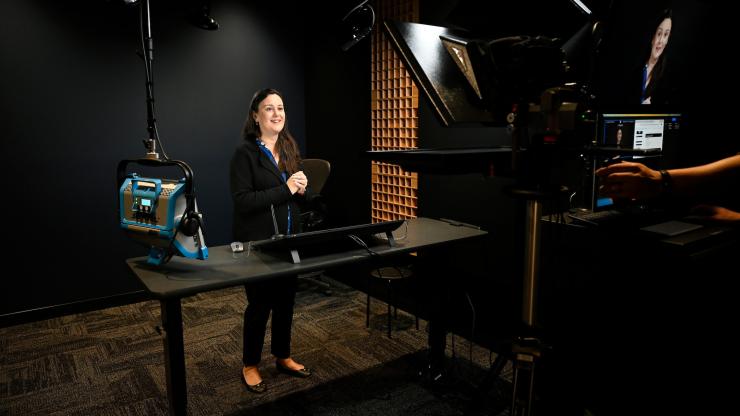
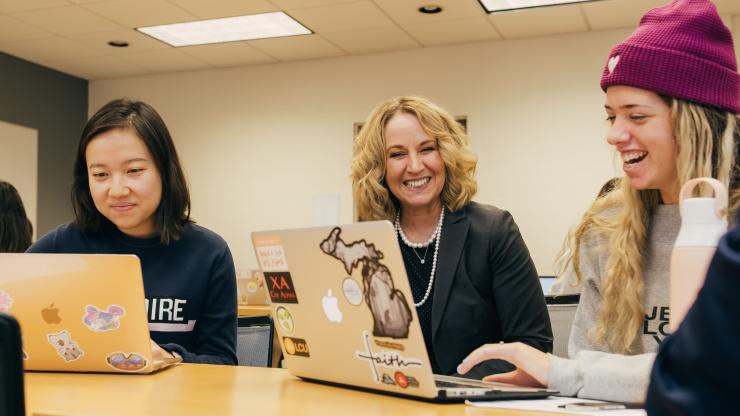
Today, Haque serves as the academic program manager for the Barger Leadership Institute (BLI) in U-M's College of Literature, Science, and the Arts (LSA). Haque trains and supervises Leadership Teaching Fellows, teaches BLI's leadership courses, and facilitates the institute's Social Transformation Fellowship.
When she is teaching about leadership, Haque often thinks back to her time with CSHPE professor Betty Overton-Adkins, who made a lasting impression. "She helped us understand the importance of centering voices that are typically not heard in higher education spaces, and she encouraged us to think about and consider histories that are not prominent," says Haque. "When I teach leadership, I am looking at how leadership is experienced by different people. What happens if you're a first generation college student? Do you consider yourself a leader? Why or why not? What examples of leadership have you seen? There are lots of experiences we have where we might see community leaders, our parents, or members of our community, but we never formally think of them as leaders. Can we take what we learn in the theories about qualities of leadership and apply it to our lived experiences so we can rewrite the story of who gets to be a leader?"
Outside of her professional capacity at BLI, Haque employs her own leadership skills as a community organizer. She served on the founding board of Rising Voices, an organization focused on developing the leadership of Asian American women and young people in the state of Michigan. In addition to serving as board president and spearheading fundraising initiatives, she helped with efforts including voter engagement, the 2020 census, and developing a youth leadership program.
Recently, Haque worked with a group of community members in Hamtramck to put together an exhibition about the Bangladeshi diaspora in Michigan for the Hamtramck Historical Museum.
The exhibition included contributions from high school students who identified as Bangladeshi Americans, a newly compiled database of Bangladeshi-owned and -operated businesses in southeast Michigan, and memorabilia from local cricket and badminton associations.
"I got to learn a lot about the community as part of this work," says Haque. "The exhibition also integrated history, recognized the emergence of Bangla Town, and showed viewers that part of Detroit is Bangladeshi, and it has been so for quite some time."
Learning for Joy
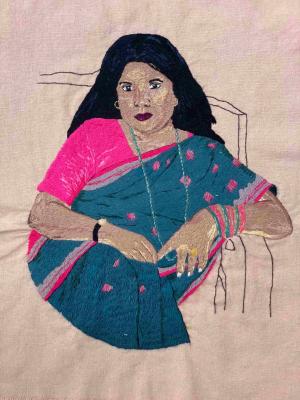
"During the pandemic, I was telling a friend that I needed a new hobby that was not scrolling my phone while watching television. She recommended cross-stitch," says Haque. Once she got the hang of the basic technique, she remembered that her mother, aunts, and grandmother had all practiced nokshi kantha, the Bengali tradition of embroidery. Haque describes nokshi kantha as a "quick running stitch," used for blankets or sometimes to create commemorative wall art, like a birth announcement. When she was young, Haque's family members discouraged her from taking up the practice, warning that she wouldn't have the patience to do it right. Now, she began incorporating it into her method.
Haque's imagination started running wild with possibilities for what she could make. Starting with her maternal grandmother, she began rendering portraits of family members in embroidery. Haque hadn't done anything like this before, so she turned to TikTok videos by makeup artists. They taught her about starting with a blank canvas and then defining features by shifting colors to show depth.
"I would just spend hours and hours doing it, first during the pandemic, and then later it became a way for me to process grief. My father had been diagnosed with Lewy body dementia, and I was a caregiver for him. Part of my self-care and grief practice was to hand-embroider and create art."
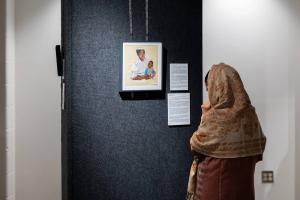
She shared her pieces on Instagram, and people started taking note. A grant from the U-M Arts Initiative enabled her to host a solo show of her work. For the show, she was inspired to draw a connection between her artistic practice and her community organizing work. She began collecting photos and gathering oral histories with community members who had immigrated to the United States and now lived in Michigan. She turned the photos into embroidered portraits and displayed them in the gallery along with the oral histories.
"I'm always encouraging my students at the university who are inclined toward the arts that creativity can be another way to lead. I advocate for people to use their creativity to help develop connections and to think about how they can reach people in a way that otherwise might not be possible."
Learning for Life
"I grew up writing. Ever since I was a little kid, I wanted to be a writer and I wanted to publish. Part of the problem was I didn't think I had enough original ideas. Furthermore, I didn't see in the books I read, or in the shows I watched, representations of myself as a South Asian American person. That affected my capacity to see myself as the main character. But as I grew older and my own ideas developed more, I began to think more critically," says Haque. "I started seeing the importance of the types of stories that I had lived through and could tell. All of my short stories feature Bangladeshi Americans in some form or fashion, whether it's the Bangladeshis who live in the U.S. or the Bangladeshis who were left behind in Bangladesh."
Haque has published her essays and short stories in literary magazines and anthologies. She has also written a novella and a collection of stories, both of which she hopes to publish soon.
"Part of my legacy as a person in general is to document these stories and share them with the world," says Haque. In addition to writing her own stories, Haque co-facilitates the Unerased Book Club, a national book club dedicated to building community through Asian American literature.
"I think that part of leadership work is being able to tell really good stories," says Haque. "Stories are the way to change people's minds, to persuade people, to get them to see the importance of things."
MORE FROM Fall 2025