


Champions for Education
New Gifts, Endowments, and Bequests

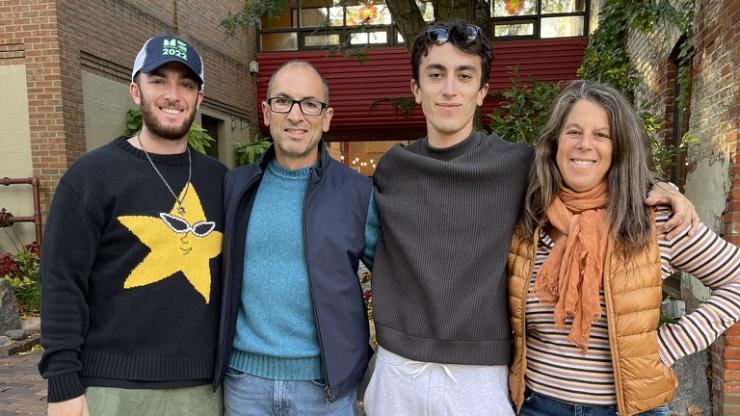
Education is a field close to the hearts of Sylvia and Paul Aversano, in part because they met in Finance 311 during their junior year at Binghamton University in New York. In addition, they both come from a long line of educators. Sylvia's father was a teacher in East Harlem, New York before becoming an assistant principal, and eventually a principal, in the Bronx, New York. After her children went to college, Sylvia's mother pursued her own degree at Queens College and became an elementary school teacher. Sylvia's middle sister became an art teacher; her youngest sister teaches ESL. On Paul's side, his sister is a math specialist who has been teaching for over 25 years on Long Island. So when the Aversanos met Dean Moje at a U-M football tailgate, they felt an immediate kinship.

"My parents didn't go to college," says Paul. "It was a big deal for both of us to attend Binghamton, and it wasn't easy for our parents to put us through college. But neither of us graduated with student loans or debt. Our philosophy is, if you're fortunate enough to do well in life, you also have to do good."
They were proud to donate to Binghamton, providing funds to upgrade the lecture hall where they first met, and to support the university's Services for Students with Disabilities by establishing a state-of-the-art assistive technology room. Instead of putting their own names on the lecture hall, they dedicated it to their parents.
Now, as members of the U-M Leadership Council & Parent Partners, the Aversanos are building on their commitment to higher education. They have recently established the The Aversano Family Scholarship Fund, an endowed scholarship to support Marsal Education students who seek to enter the teaching profession.
The Aversanos' oldest daughter attends Iona University in New York. Their middle daughter, Olivia, has recently declared her communications major in the College of Literature, Science, and the Arts at U-M. And their youngest daughter—still in high school—already knows she wants to follow in the family tradition and become a teacher—and hopefully attend U-M as well.
"I'm always looking for scenarios where we can create wins across the board," says Paul. "If you look at this, the Marsal Family School of Education wins. The students win. And we feel like we're winning because we're supporting something that's important to our family."
Since the age of two, Kevin Collins (BBA '93, AM '99, TeachCert '99) could draw any cartoon he saw, recalls his sister, Kim (Collins) Blanding (BBA '99). He brought his creative spirit with him when he came to the University of Michigan to study business as an undergraduate. After graduating, Collins worked in the advertising world for firms including the Leo Burnett Company in Chicago, and later, Wieden+Kennedy in Portland, Oregon. But after several years in the industry, he decided that he wanted to give back to the community, and to do so by becoming a teacher.
Coming from a family of "diehard" U-M fans, there was no question Collins would return to his alma mater to pursue a master's degree in education.

"He had a great experience as part of the Master's of Arts and Certification in Elementary Education," says Blanding. "I think it really catapulted him to not just teach with confidence, but it equipped him with the skills so that he could successfully change careers. It's a pretty big shift to go from the advertising industry to being an elementary school teacher."

For Collins, the experience was eye-opening. He was able to do his student teaching in Detroit, and developed a passion for helping children early on in their education. He went on to teach kindergarten and fourth grade in Fenton, Michigan at Fenton Elementary School, becoming a beloved member of the school community and a nominee for the Michigan Teacher of the Year award.
"He had a fun, messy classroom with Play-Doh and arts and crafts—all kinds of stuff. He just really had a passion for teaching kids and giving them that creative spirit," says Blanding.
The school was a half-hour drive from Collins' home. During his commute, he thought of ideas for children's books. His dashboard was covered in Post-it® notes about characters and plots. He self-published a book about a race car, and another about a farm that was running out of money so the animals created a golf course to keep it in business. Yet another book was about a squirrel named Earl, inspired by the many squirrels Collins encountered running around Ann Arbor.

Collins passed away suddenly in 2014. To build on his legacy, his sister Kim and brother-in-law Todd Blanding (BBA '99), have established the Kevin M. Collins Scholarship Fund.
"We thought there was no better way to honor him than to help support the next generation of fun, creative, and passionate teachers," says Kim. "I'm really honored that we have the opportunity to contribute, and to hopefully help someone who wouldn't have been able to be a teacher now become one."
"My parents were the best teachers I ever had," says Margaret E. "Margie" Gaudin (AB '85, TeachCert '86). "They both devoted their careers to education."
Gaudin's mother served for years as an elementary school librarian at McKenny Elementary School in Detroit, while her father progressed from teacher to principal, and ultimately became superintendent of special education in Detroit Public Schools. But when she reflects on her parents' legacy, it's not just their service to the city and the families of Detroit that strikes her—it's also that they were able to send all eight of their children to college.
At the University of Michigan, Gaudin earned her bachelor's degree in English literature before staying on to obtain her teaching certification at the School of Education. She went on to teach in high schools across Chicago, Baltimore, and New York City, where she shared her passion for literature with her students. "Teaching was very meaningful to me," she recalls, describing her time in the classroom as both challenging and rewarding.
Throughout her time at U-M, Gaudin held jobs to supplement her parents' support. She understands well the financial pressures students face. "It takes a lot to educate oneself today," she says.
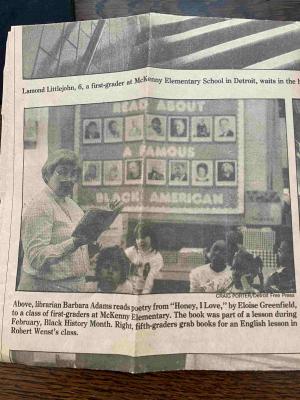
A deep appreciation for the example her parents set inspired Gaudin and her husband, Paul B. Gaudin (AB '86, MD '90), to establish the endowed Barbara J. and George F. Adams Scholarship Fund in honor of Margie's parents, ensuring an enduring impact on future educators.
The Gaudins' gift is motivated by their appreciation for educators and the practical burdens they shoulder. "Teachers are chronically, uniformly, and universally underpaid for the important work that they do," says Gaudin. Her family's scholarship aims to "relieve a burden where we could, so that someone can do what they feel in their heart they'd like to do."
For the Gaudins, the satisfaction of giving comes from seeing the real impact a scholarship can make. "It's great to hear from the students who receive the funding...they are so thankful. It's heartwarming. We love hearing about someone who just has a little ease of burden."
In 1970, the decision to accept a job at the University of Michigan as director of the Program for Educational Opportunity and lecturer in education, set in motion a series of events that changed the trajectory of Charles David Moody Sr.'s life. That decision had just as profound an impact on his son, C. David (Dave) Moody Jr., who was just 14 at the time.
The family had been living on the south side of Chicago. There, Charles had finished his PhD and was serving as one of the country's youngest Black school superintendents. His wife, Christella, was an educator who was born and raised in the city. It was a difficult decision to uproot their family, but opportunity beckoned.
"When we moved to Ann Arbor, it was just two years after Dr. King had been assassinated. The Civil Rights Act was only five years old," recalls Dave. Schools were in the midst of integrating. With the Program for Educational Opportunity, his father "was involved with trying to make sure that all kids had a fair chance and that the school systems were equal."

Dave had already discovered in Chicago that he liked drafting, but it wasn't until moving to Ann Arbor that he met a Black architect for the first time.
"That made me realize I could be more than a draftsman. I could actually be an architect."
That architect, David Byrd, became a mentor to the younger Moody, and set him on his professional journey. In addition to that fortuitous meeting, it was in Ann Arbor that he met his father's U-M colleagues, Dr. Henry Johnson and Dr. Billy Joe Evans, both of whom had attended Morehouse College. They encouraged him to send his football tapes to Morehouse, which ultimately led to a football scholarship and an opportunity to pursue his undergraduate degree. He went on to earn a master's degree in architecture from Howard University, and then returned to Ann Arbor to begin his career working at the Bechtel Corporation. Back in town, he reconnected with a high school acquaintance, Karla Knox, whom he married in 1982. The next year, they moved to Atlanta, and in 1987 opened C.D. Moody Construction.
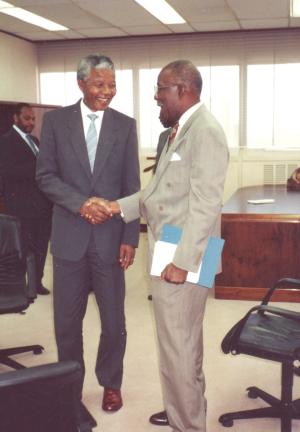
Meanwhile, Moody's father was forging a distinguished path at U-M. Charles was promoted to assistant professor in 1971, associate professor in 1975, and professor in 1980. He chaired the Marsal School's Division of Educational Specialists from 1973 to 1977, and served as the university's first vice provost for minority affairs until 1993, when he became executive director of South African Initiatives. He and his wife traveled to South Africa several times, where they had the opportunity to meet Nelson Mandela, and present him with an honorary degree from the University of Michigan. On one trip, they proudly took a photograph of the anti-apartheid activist and politician wearing a hat from their son's construction company.
During his 35 years in the field, Charles earned a national reputation. He founded the National Alliance of Black School Educators, and his 1970 dissertation on Black superintendents resulted in the formation of the National Alliance of Black School Educators, (NABSE.) Today, NABSE has 5,000 members and 100 affiliates across the United States.
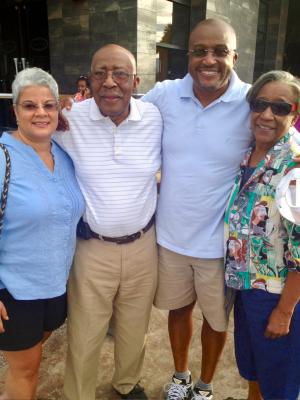
"My dad loved working for the University of Michigan, going to the Michigan football games, the bowl games, and meeting so many people across the university," recalls Dave. When his father retired from the university in 1996, he became vice provost emeritus and professor emeritus.
"When I look back and think about the things that changed my life for the better, my dad having the courage to take that job at the University of Michigan really created something special for us," says Dave. To honor his parents' memory, he and Karla recently established the Dr. Charles D. and Christella D. Moody Scholarship Fund, an endowed fund that will provide need-based scholarships to future generations of Marsal Education students.
"One of the greatest gifts we can provide is to give back so others can have an opportunity," says Dave. "I think back to my own football scholarship. Somebody had to give money for me to have that opportunity. Every gift matters. It's not how much you give, it's that you give. There's somebody whose life you'll change."
Not only did Ed Roeber (AB ’66, AM ’67, PhD ’71) earn his doctoral degree from the Marsal School, he literally grew up in the school’s halls—his father was a professor who oversaw a program that trained students to become guidance counselors. He fondly remembers joining school picnics and softball games as a kid, and says he always knew he wanted to go into the field of education himself.
By the time he entered the school as a PhD student, Roeber was captivated by the field of assessment. After taking a course with Professor Frank Womer, he went on to work for him at the National Assessment of Educational Progress, part of the Education Commission of the States. After three years, Roeber moved to the Michigan Department of Education. There, he directed assessment and accountability for 25 years.
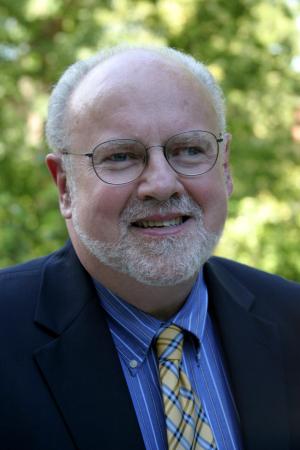
Over the course of his career, Roeber has served as vice president at Measured Progress, and directed the student assessment program at the Council of Chief State School Officers. In 2007, he co-founded the Michigan Assessment Consortium (MAC), a professional association focused on improving student learning and achievement through a system of coherent curriculum, balanced assessment, and effective instruction. He remains focused on developing resources to improve the assessment literacy of Michigan educators, policymakers, and other citizens based on MAC’s Assessment Literacy Standards.
In addition to donating to their church and various other organizations, Roeber and his wife Deborah Roeber have what they call a “generosity fund.” When they tip a server who is working on a holiday, or encounter people in the course of their daily lives whose efforts they would like to recognize, or meet someone who needs assistance of some kind, they dip into their generosity fund.
“I’m always listening, thinking, looking for who’s doing something that’s commendable…or they’re down and out, they need help, they’re struggling, they don’t know how they’re going to pay their bills,” says Roeber.
Once he was on a plane when he heard the pilot announce that it would be the flight attendant’s last flight for the company. When Roeber asked the flight attendant what he planned to do next, he said that he had been accepted to a college where he would pursue a degree in engineering.
After the plane landed, Roeber waited for all the other passengers to exit. Then he took the empty wrapper from his packet of Biscoff cookies, and slipped $100 inside. On his way out, he handed it to the flight attendant.
“Let me buy your first college credit hour,” he said. “Good luck with your degree program.”
Roeber has extended his generosity once more to establish the Edward and Deborah Roeber Scholarship Fund at the Marsal School, a need-based scholarship for students in the Educator Preparation Program. The aim of this scholarship fund is to support first-generation college attendees who seek to become teachers. As he said to the flight attendant, “I’m an educator. I love to see people who are going to pursue higher education.”
When they established the Stephen and Meli Rose Endowed Fund for Math Education—specifically to support the innovative teacher preparation program at The School at Marygrove—their motivations were both personal and forward-looking.
"I have fond childhood memories of building numeracy by playing games and working on mental math, trying to gain insights and find shortcuts," says Stephen Rose. Now he understands that racing elementary school classmates at the blackboard to do multiplication or long division problems might not have been everyone's idea of a good time, but for Rose, it was the best part of his day. "Math has just always been fun for me."
In addition to his career as a transactional tax attorney, Rose has spent decades teaching as well as coaching and mentoring young people in math—from his time as an adjunct law professor to his years volunteering as a middle school math coach. During the COVID-19 pandemic, he returned to graduate school to earn a master's degree in math education with the desire to help underserved students recognize their potential in math.
And yet, as much as Rose loves math, he is also sensitive to the fact that many students don't take to it naturally, or suffer from inadequate support. Growing up, his older sister thought of herself as "not a math person." And Meli Rose, whose father was a physicist and an electrical engineer, struggled with math anxiety. Despite this anxiety, Meli's father taught her the importance of having a solid math base because math concepts build upon each other. For these reasons, the Roses believe strongly in training and supporting excellent math teachers.
"I think math education is so important—especially early math education," says Stephen. He stresses that success in math isn't about inherent abilities, but rather students' perceptions about the subject. "Everyone can be as good as they want to be if they're persistent and have the right teachers at the right times in their life."
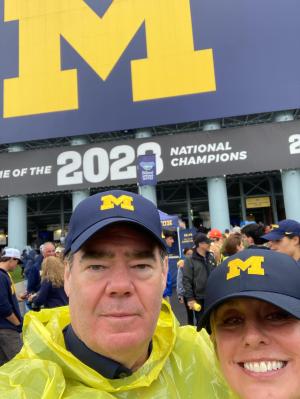
As parents of a current U-M senior, the Roses are members of the university's Parent & Family Leadership Council, and regularly hear from representatives of schools and colleges across the university. They have enjoyed presentations on electric cars, astronomy, ancient books, and the Michigan Marching Band, but when they heard about the Marsal School and its initiatives with the Marygrove Learning Community in Detroit, they were deeply affected. The School at Marygrove struck the Roses as a place where innovative, research-based teaching practices could be tried and leveraged to prepare the next generation of passionate, thoughtful math teachers.
The Roses hope their gift will help teaching interns and residents at The School at Marygrove gain the skills and awareness necessary to dispel anxiety and foster lifelong mathematical curiosity. Their generosity is grounded in their belief that empowering math educators has ripple effects, reaching far beyond one classroom or school.
"My dream," says Stephen, "would be that the example set by The School at Marygrove can be leveraged and rolled out to many, many schools"—helping spread not just mathematical skill, but the confidence and joy that come with it.
MORE FROM Fall 2025