


Museums as Spaces for Democratic Engagement
A symposium co-hosted by the Marsal School and U-M Museum of Art invited experts from a variety of backgrounds to discuss approaches to visitor participation in galleries

Learning happens everywhere—in classrooms, certainly, but also in many other spaces beyond school settings. Take museums, for example. Most students spend time on field trips to museums at some point during their primary and secondary school careers. And increasingly, visitors of all ages are being prompted to engage with exhibitions through interactive elements woven into the curatorial design. But what considerations go into developing audience engagement opportunities? And what do such opportunities actually do for participants? In search of answers to these questions, collaborators Vicki Shaw, who has led the Marsal School's partnerships with arts organizations for over a decade; Jim Leija, former deputy director of public experience and learning at the University of Michigan Museum of Art (UMMA); and Jason Young, director of the U-M Institute for the Humanities, examined over 5,000 artifacts created by museumgoers.
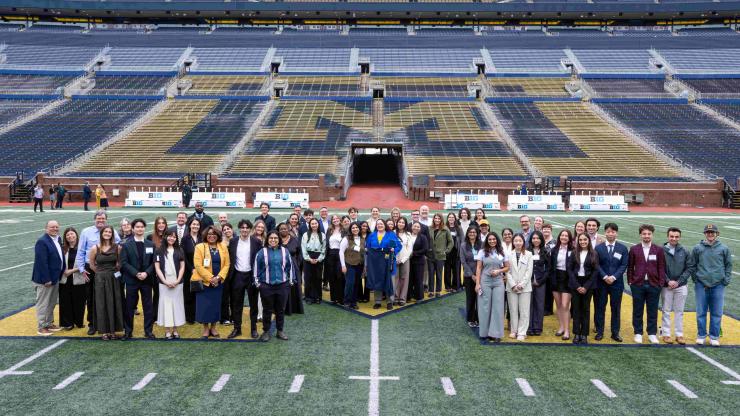
With a grant from the Year of Democracy, Civic Empowerment, and Global Engagement (the university's inaugural theme year in 2024–25), the collaborators set out to research museums as underexplored sites for the sharing of ideas and perspectives required for civic engagement and democratic dialogue. In May, they presented their project at Democratic Dialogue at the Museum, a symposium co-hosted by the Marsal School and UMMA that invited museum and arts educators, curators, community engagement specialists, artists, and university faculty in arts, humanities, and education to explore the questions raised by examining visitor-created responses to art exhibitions.
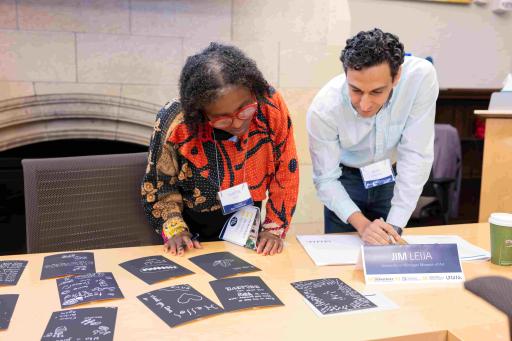
"Interactive elements are a common feature in the museum world today," says Shaw. "They're great—they increase visitor engagement—but they're not really theorized. We started to think about these artifacts as a participation structure to which we could apply education thinking." Shaw realized that, in addition to engaging visitors as they create them, the artifacts provide the museum with a formative assessment of the visitor experience in the gallery. What was the potential for the engagement strategies—or the artifacts themselves—to extend the life of an exhibition? How might a teacher develop similar practices to make a lesson go further?
To conduct their research, Shaw, Leija, and Young examined responses produced by visitors to two recent exhibitions at UMMA. Hear Me Now: The Black Potters of Old Edgefield, South Carolina, a traveling exhibition of ceramics created by enslaved people and contemporary artists, invited visitors to write messages they wanted to carry forward to future generations. Visitors were given cards that they could scratch their responses into—a process that mimicked the technique of scratching on clay which was employed in the creation of the ceramics on display.
Hey, We Need To Talk!, a social sculpture by artist Philippa Pham Hughes, asked visitors to reflect on what it means to be American and to flourish. To do so, visitors were provided postcards to write on. Responses were collected and accumulated in binders that visitors could page through.
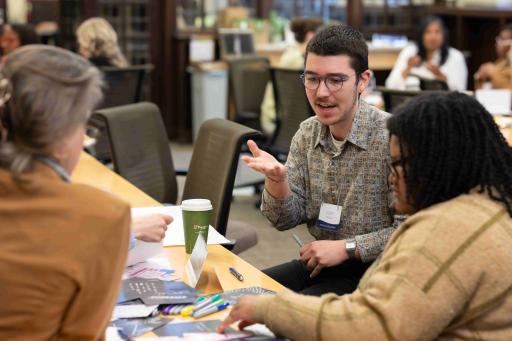
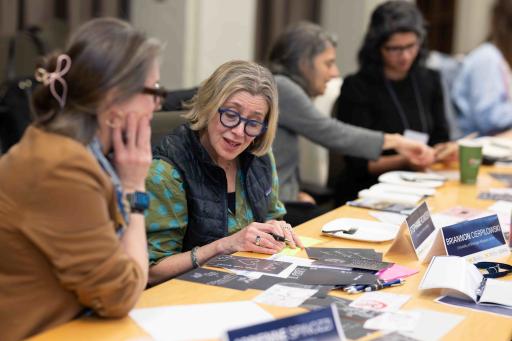
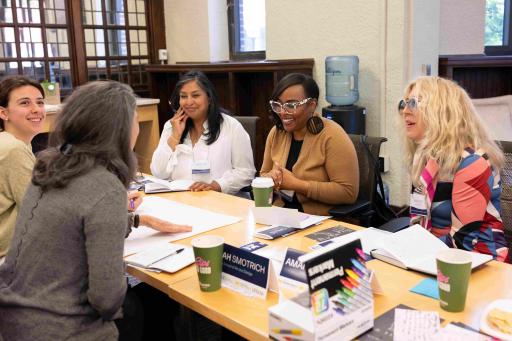
What did the visitor responses reveal about the ways visitors engaged with the exhibitions? How were visitors interacting with each other through their responses? These were just some of the questions that arose for Shaw, Leija, and Young as they processed the artifacts. Using their research as an example, they opened a discussion about these topics with over 30 invited participants who collectively considered how interactive gallery experiences might be designed more deliberately. Representing an array of disciplines, guests of the two-day symposium shared their perspectives and experience as teachers, artists, curators, and museum educators, as well as professors of visual art, the humanities, and education—including the Marsal School's own Natalie Davis, assistant professor of critical studies in education.
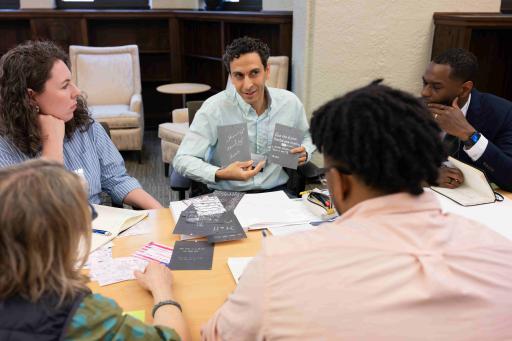
Shaw and Leija facilitated the symposium, leading participants through three modules—Immersion, Activating Experience, and Opening Up—that guided a collective thought process. Participants, who brought a range of professional backgrounds and perspectives to the discussion, engaged deeply with the artifacts and the research team's questions, then began sharing questions of their own. Themes including intention, ethics, and motivation surfaced as the group's analysis homed in deeper. The discussion culminated in the creation of a proto-heuristic for museums to use when designing visitor engagement opportunities. Recommendations included: prototyping and testing engagement design with visitors before exhibitions open; building in accessibility from the start; designing for multiple modes and entry points; being thoughtful about display; and considering what visitors take away from the exhibition as well as what they leave behind at the museum.
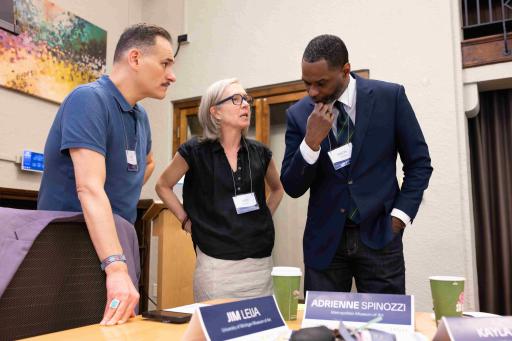
As the symposium drew to a close, participants took time to reflect individually and share concrete actions they wanted to take or explore in the next six months as a result of the conversation. For Shaw, the experience will inform a class she is co-teaching this fall with fellow Marsal School lecturer Katie Robertson, and Grace VanderVliet, curator for museum teaching and learning at UMMA. The class is designed for arts-focused undergraduates who seek to become teaching artists. The course will introduce methodologies to practice centering the student—or gallery visitor of any age—rather than the art itself.
"The Marsal School is thinking institutionally about education that happens in non-classroom settings," says Shaw. "Often the practice of education is taken for granted. I think it is useful for us to help folks across campus and at peer organizations understand the expertise that education schools bring. At Marsal, we think a lot about how we can help learning happen, how we can facilitate learning and engagement so that we're not just transmitting data or information."
MORE FROM Fall 2026