


CSHPE Students Take Top Placement at Campus of the Future Student Idea Showcase
Envisioning the Campus of the Future is a core tenet of the Life-Changing Education Theme Initiative

As the Life-Changing Education (LCE) initiative continues its work from the 2025–26 Theme Year into the current academic year, students in the Marsal School's Center for the Study of Higher and Postsecondary Education (CSHPE) are bringing to life the ideas they put forward in April as finalists at the Student Idea Showcase Gala.
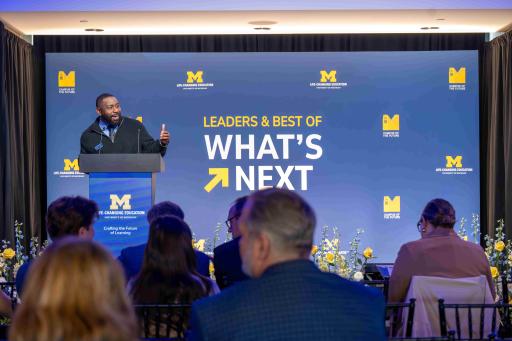
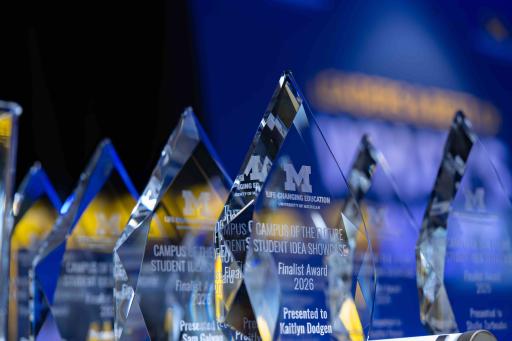
Campus of the Future—one of the theme year's Four Ways—brings students, faculty, and staff together to pair historical reflection with student-led innovation, experimenting with new tools and spaces to improve learning at the University of Michigan and beyond. The Campus of the Future Student Idea Showcase, a multidisciplinary design competition, invited students to lead the conversation on the future of higher education. Drawing students from across all schools and colleges, the competition called for proposals to transform Michigan's educational experience. More than 700 proposals were submitted. A panel of 12 judges, made up of U-M staff and faculty members associated with the entrepreneurship and innovation community, scored proposals using a rubric developed specifically for the event. Of the five finalist teams chosen to present their concepts to a panel of senior university leaders for feedback, recognition, and potential institutional adoption, two were composed of CSHPE students.
"I think students are attracted to CSHPE and careers in higher education because they see all the needs in higher education and want to be change-makers," says Demetri Morgan, a CSHPE faculty member and faculty director for the Year of Life-Changing Education. "The showcase created a pathway to ideate and build out their ideas for how higher education might do things differently, bridging what they do in their classes and internships with their future goals."
"We study colleges specifically," says second year CSHPE graduate student Sam Galvan. "The questions this call was asking are things we think about all the time as we study higher education. We're always thinking about how campuses can do better to serve students."
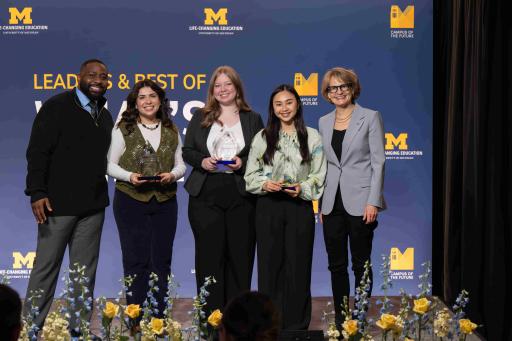
At the Student Idea Showcase, Galvan, along with fellow CSHPE doctoral students Vivian Nguyen, Kaitlyn Dodgen, and Dreama Rhodes, presented Michigan in Motion: Walking and Biking-Centered Experiential Learning, an experiential learning program which would aim to boost student engagement by fostering meaningful relationships among U-M students and neighboring communities. Through research-informed, themed tours in Ann Arbor and surrounding areas, students will explore local histories, civic challenges, art, and community-driven problem-solving. The tours would be offered in accessible, multimodal formats (e.g., walking, rolling, biking, and transit).
Three of the four teammates hail from California. As U-M graduate students themselves, Galvan says she and her collaborators felt they didn't know how to connect with the community surrounding the university where they studied. Inspired by LCE's emphasis on sustainability and experiential learning, they looked to resources that were already available. Students can rent bikes, and there are plenty of free buses.
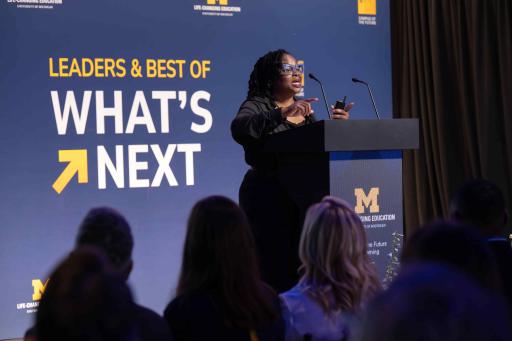
"We were thinking about some of the other campuses we've seen that offer walking and biking tours. We wanted a way to interact with the Ann Arbor community while also being outside and taking advantage of nature. With Michigan in Motion, we hope to create a multifaceted learning experience that bridges the gap between community partners and the campus."
On April 10, at the Jack Roth Stadium Club inside Michigan Stadium, the team presented their idea to an audience of U-M administrators that included Provost Laurie McCauley, University Secretary Jon Kinsey, Regent Carl J. Meyers, and Amy Homkes-Hayes, Look to Michigan executive director of strategy and implementation. Other campus leaders who attended the event included Angela Dillard, co-chair of the Year of Life-Changing Education, Mika LaVaque-Mant, co-chair of the Campus of the Future initiative, and a range of deans and department chairs.
"Education, in my opinion, is at its best when it is collaborative, imaginative, and civic-minded, and the Showcase was an embodiment of this," says Nguyen. "Not only was it exciting to apply what I've learned as a graduate student in the Marsal Family School of Education to design campus programming, but it was also invaluable to receive feedback from faculty, staff, community members, and students in attendance of how they want to be involved in Michigan in Motion's development, as well as ideas for future tour themes."
"Lots of offices across campus came up to us afterwards and expressed their interest in our project," says Dodgen. "On a broader note, it helped me feel more connected to different parts of the university outside of CSHPE."
Also representing CSHPE at the Student Idea Showcase was Devan Safford, now a second-year graduate student focusing on public policy. Safford presented Identity Beyond the Checkbox with Samantha Cellar of LSA, a project born out of a Student Life research initiative. As Safford explains it, the research team with whom she was doing an internship had been working on an ecological validation study. Ecological validation is an educational framework that supports students by acknowledging their unique identities, strengths, and life experiences across a connected network of campus environments. Through their research, the idea surfaced to establish an online tool that would connect university students with resources based on personal identities outside of those that were usually seen on checkbox forms. The team envisioned attaching the tool to MCommunity, the directory of people and groups at the University of Michigan.
"Students could go in based on identities like being a first generation student or being the oldest sibling—some of the things we don't often think of when we create different forms for students to connect to opportunities," says Safford. "This tool would help students identify resources that are relevant to their most salient identities."
This dataset would allow identities to be dynamic and student-defined, helping foster connection, support, and opportunity across campus.
"When you think of students who are typically left out of the pool, ecological validation allows them to be themselves and identify with institutions more appropriately. It places the responsibility for connecting students to the institution on the institution rather than the student. It makes the university a little bit more responsible for digging deeper into what is important to students, what is valid to students—not only in a social manner, but academically as well." In addition to helping students feel more connected, the tool would be of great use to professors who could use their students' profiles to build learning environments that are, in Safford's words, "valuable, useful, and comfortable for them."
Safford had just completed a statistics course with CSHPE Professor Walt Ecton when she began working on the research project that inspired Identity Beyond the Checkbox. She credits Ecton's course with helping her understand where qualitative research fits into the broader context of higher education, and the importance of ecological validation.
"I myself am considered a minority for many reasons. I am an African American female. I'm a nontraditional student. I have a disability. These characteristics put me into several categories that traditionally classify me as a minority student," says Safford. "As I entered the program, I wanted to put that classification into a box, not to be opened as part of my research. I did not want to focus on minority initiatives. I live it every day. And so sometimes it becomes a little overwhelming and exhausting. CSHPE reminded me that my minority perspective is not a disadvantage, it is an advantage and it is a priority. "
Student Idea Showcase finalist teams received $500 to pilot their ideas. In addition, the Life-Changing Education office has created a Campus of the Future Fellows cohort for finalists and semi-finalists interested in pursuing their projects further. The LCE office will facilitate connections with university resources, provide administrative and marketing support, and create an organized effort to help fellows further develop their ideas and skills.
Nguyen, Galvan, Dodgen, and Safford will serve as Campus of the Future Fellows during the 2026–27 academic year. "Since the showcase, I have been in conversation with campus partners that also facilitate place-based, experiential learning to see how Michigan in Motion can best support and fit into the U-M campus experience," says Nguyen. "Our goal for the year is to design curricular materials, facilitate a series of pilot tours, and collect feedback from collaborating units and student participants that can help inform a second set of tours in the following academic year."
The team is also thinking about the long-term viability of their project as they acknowledge that they will eventually graduate and move beyond CSHPE and the university. Where will Michigan in Motion live? Who will staff it?
"There's so much research about how one-off events don't really affect the student experience," says Galvan. "What works are repeated points of contact, programs, and cohorts. We are trying to build Michigan in Motion as a program that could live in an existing office where a staff member has the capacity to facilitate it."
Developing the tool is one step; implementing it is another. To bring Identity Beyond the Checkbox to fruition, Safford is continuing to conduct research and identifying campus partners. "It requires a bit more fact finding in regard to where it could and should be housed, where it could have the most impact, and where it could establish longevity. We've had to slow things down a bit just to identify who we should be working with, and who are the most appropriate partners at the University of Michigan."
In the winter semester, the Marsal School and the Ross School of Business will co-lead a course that replicates the Campus of the Future Student Idea Showcase project development process. Led by Tim Webb of the Ross School of Business, a key member of the Student Idea Showcase planning team, the course will incorporate components such as mentoring and networking sessions, one-on-one feedback meetings, and project development checkpoints for students. Students who participated in the showcase last winter are welcome to enroll for further project development; it is also open to new students with ideas for improving the U-M campus in the future.
"It was important to us that the Campus of the Future not solely be something designed by faculty and administrators for students," says Morgan. "Our various efforts have all been done with the vision of creating real and tangible pathways for students to collaborate with each other and the university to build a campus that is more responsive, inclusive, and enabling of student success."
MORE FROM Fall 2026