


From Asia to Ann Arbor and Back Again
Learning about the lives of two Marsal School alumni—who were students nearly 100 years apart—at the Pan-Asia Reunion

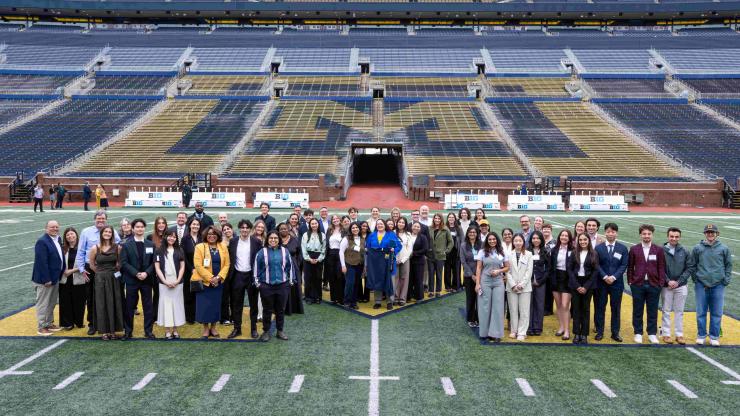
Each year, the Pan-Asia Reunion gathers University of Michigan alumni and donors to reconnect with one another and celebrate their shared experience as Wolverines. In the spring of 2026, Dean Elizabeth Birr Moje, Senior Associate Dean for Research and Graduate Affairs Michael Bastedo, and Director of Development and Alumni Relations Krissa Rumsey traveled to Tokyo to attend the annual convening. There, they were struck by the stories of two alumni in particular—one who attended U-M in the 1930s, and the other who graduated nearly a century later, in 2024—who remind us of the global impact the Marsal School has always had.
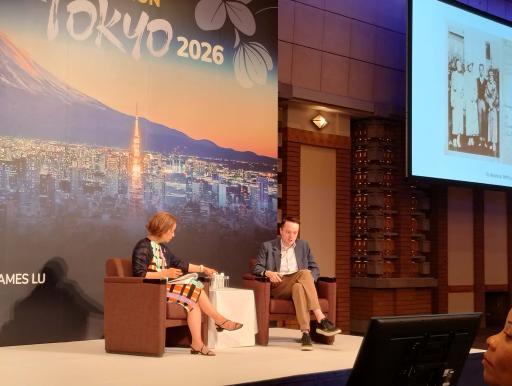
Speaking at the reunion's opening session, Edward Mears (JD '16) introduced the audience to his grandmother, Estelle Veronica Mislik Mears, the daughter of Polish immigrants, who grew up in Flint and became the first in her family to attend college. Mears didn't know his grandmother well—she died in 1992, when he was young. But years later, as he and his father were cleaning out a family storage locker, he discovered a box of his grandmother's belongings. Inside the box was a faded photo of Estelle from her days as an undergraduate at U-M. She stood beside a young Chinese man in front of the former Alpha Lambda Chinese fraternity at 1402 Hill Street in Ann Arbor. The photo had been taken in May 1933. The inscription "To Veronica, with love, Ben," was written across the bottom. On the back of the photo, she had written her friend's full name, "Benjamin King."
Mears remembers his grandmother as loving, and always encouraging him and his sister to read; however, she passed away long before he was old enough to ask her about her college years. The photo prompted Mears' desire to learn more about her life, and hinted at a friendship that crossed national, racial, and political lines during a volatile period of history.
Mears, a corporate lawyer and long-term resident of Tokyo, began a quest to learn more about his grandmother and her unlikely friendship with Benjamin King in 1930s Ann Arbor. Looking through Michigan Daily archives, he learned that his grandmother had served as the secretary for the 1933 International Students Conference on World Affairs. King served as chair of the conference's World Politics Commission. The four-day conference gathered students and professors to debate the rise of Nazism, American-Soviet relations, and the Sino-Japanese conflict, adhering to a procedure modeled on the League of Nations. Mears suspects working together on the conference was the beginning of their friendship. "It also recast my grandmother, whom I had only known as a provincial schoolteacher, as a campus leader engaged in international issues," says Mears.
Estelle overcame a number of obstacles in order to attend the university. After an injury rendered her father unable to work, he abandoned the family. Estelle's mother, who didn't speak English, was left to raise three children on her own. In addition to doing odd jobs for neighbors, she ran a "blind pig" to make ends meet—an underground bar in their home, which was common, if illegal, during Prohibition. Estelle's mother was arrested twice for serving alcohol, but the need to provide for her family outweighed the consequences. The third time she was caught, she was arrested by the federal government. Estelle attended the court proceedings to translate for her mother, and wrote a letter to Judge Arthur A. Tuttle who oversaw her case in court, pleading with him to let her mother go as she was the family's sole provider. Still, her mother was sentenced to a year of confinement, and sent to Federal Prison Camp, Alderson in West Virginia.
Although Judge Tuttle was not swayed by Estelle's letter, Mears believes that he and her mother's lawyers were impressed by Estelle's comportment and the skills she presented throughout the trial, and encouraged her to apply to U-M, where Judge Tuttle had attended law school. In her student file, which Mears pored over at the Bentley Historical Library, she listed one of her mother's lawyers as a reference.
Estelle attended what was then the School of Education (although she ultimately graduated from the newly opened Wayne State College of Education) and went on to begin her teaching career in Detroit. After several years she wound up back in Flint, where she was raised, and spent the majority of her career in the Flint Community Schools district, where she served as a fifth grade teacher until her retirement.
In addition to learning more about his grandmother, Mears became intrigued by her friend, Benjamin King, the son of a merchant who came to Michigan from Hangzhou, China in 1930 to earn a master's degree in municipal administration. King then enrolled in the Law School, and ultimately earned a master of science in engineering in 1933 before returning to China. King, Mears learned, went on to work for the National Commercial Bank of China in Shanghai. He was also a member of the Rotary Club and vice president of the University of Michigan Alumni Club of Shanghai from 1939 to 1940, during the Japanese occupation.
Mears' research on his grandmother, Benjamin King, and their unlikely friendship resulted in articles for the Bentley Library's Collections Magazine and Michigan Law Quadrangle. When he posted about his quest on social media, the story went viral. Phoenix Television, a Chinese satellite television network, produced "Searching for Benjamin King," a half-hour documentary about his journey, which aired in early 2025. The visibility from the documentary led to a breakthrough Mears had been hoping for—on a return visit to Hangzhou he met one of Benjamin's relatives, Kainan Jin. Jin shared an email from King's daughter, who recounted how her father had always stirred his morning coffee with a spoon engraved with "The University of Michigan League." Furthermore, when Mears returned to Japan, a friend who owned an antique store called him. A collector he was in touch with had located one of King's photo albums.
"Emblazoned with the University of Michigan seal, the album contains candid snapshots of campus life: classmates in the Law Quad, football games at the Big House, and photos of Benjamin's fraternity brothers," wrote Mears in his piece for Quadrangle. "Most moving were two photographs of my grandmother: one in a cap and gown and another in a dress and coat, both dated March 1933. On the front of the second photo she wrote, 'To Benjamin, Yours, Veronica.' On the back, in neat cursive, 'To one of the nicest boys I've ever known at Michigan.'"
Mears marvels that the photo album survived wars, the Japanese occupation, and the Cultural Revolution, before resurfacing in 2025.
"At a time when few American students socialized with their foreign peers, my grandmother and Benjamin had formed a genuine friendship built on shared curiosity about the world." One imagines the experience of such a friendship—and their time together at Michigan—remained with each of them, on different sides of the world, throughout their lives.
Fast forward almost 100 years to present-day Tokyo, where Abdullah Bo Shgeia (AM '24) was teaching kindergarten at an international school. After five years in the classroom, Bo Shgeia found himself frustrated with the management style of his school's administration. He wanted to become a school leader himself, but aspired to practice a different method of management. He enrolled in the Marsal School's Educational Leadership and Policy program, and moved to Ann Arbor to take the next step in his career.
"The program was so impactful because of the professors who took care of me," says Bo Shgeia. "They showed me how to be a leader. They showed me what it is to inspire people. After meeting them, I realized that leadership is personal. It's you showing up as your best self. That's what impacts the students and the teachers around you."
Just as he was about to graduate, Bo Shgeia received an email from the parent of two of his former kindergarten students, back in Japan. Maria Asakura, a professional singer, was starting an after-school program where elementary students could continue their study of English while learning to sing, dance, and develop self expression. She asked Bo Shgeia if he would like to collaborate with her.
Today, Bo Shgeia is a founding member of GENSEKI Musical Entertainment School in Tokyo.
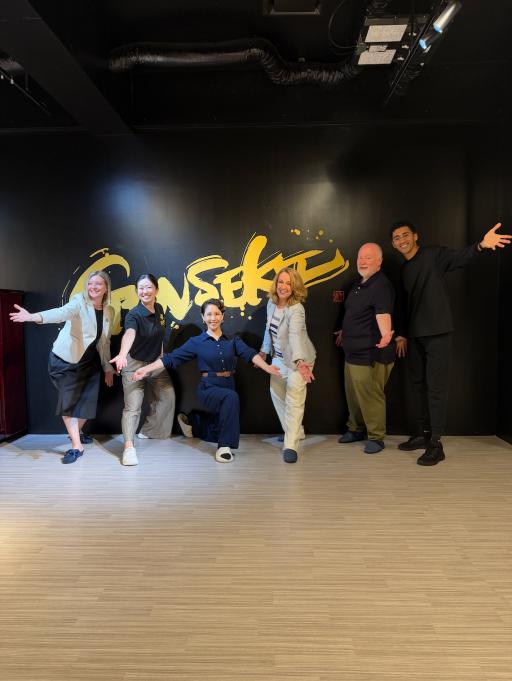
"We teach singing, dance, and acting in English," explains Bo Shgeia. "We cover musicals like Annie, Wicked, and Disney classics. We teach students the context of the movies, as well as the songs. At the same time, we maintain strong phonics instruction as a foundation for language development."
Asakura and a team of professional artists provide musical instruction. Bo Shgeia, who is TEFL certified, brings his passion and experience for helping children discover the joy and possibilities of learning English.
GENSEKI has been open for one year, and currently serves 30 students. By creating stage productions that use both Japanese and English, GENSEKI aims to nurture the development of "global expressiveness, communication skills, and at the same time, social skills and morality."
While they were in Tokyo, Moje, Bastedo, and Rumsey visited GENSEKI to see Bo Shgeia and Asakura's program in action.
"We had a wonderful discussion about how we can create learning environments where students are not only prepared for success, but also experience love and support from their teachers and fellow classmates," says Bo Shgeia. "Our goal is not only to help students communicate in English, but also to develop the confidence to express themselves authentically."
During their tour of GENSEKI, Moje shared the principle that guides the Detroit Public Schools Community District, "Every child deserves to be loved, challenged, and prepared." That notion resonated deeply with Bo Shgeia.
"Love and intentional teaching go hand in hand. We believe this principle extends beyond public schools to all learning environments, including informal educational settings," he says. "We left the conversation feeling inspired and even more committed to creating learning environments where students feel loved, challenged, and prepared for whatever comes next."
Across time and distance, the stories of Estelle Veronica Mislik Mears and Abdullah Bo Shgeia demonstrate the enduring global reach of a Michigan education. Nearly a century apart, both carried relationships, lessons, and values formed in Ann Arbor into classrooms and communities across the world. Their lives and contributions remind us that the connections made at the Marsal School can transcend borders and generations—shaping not only individual journeys, but also the lives of those who come next.
MORE FROM Fall 2026