


Angela Calabrese Barton
Connect
Location
4218 SEB
610 E. University Ave.
Ann Arbor, Michigan 48109-1259
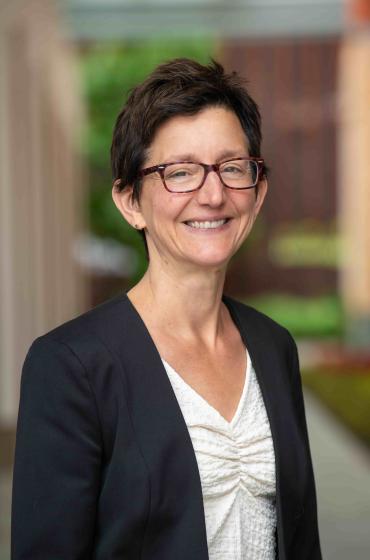
Angela Calabrese Barton is the Alvin Demar Loving Sr. Collegiate Professor of Education in Educational Studies at the University of Michigan. A former chemistry teacher and informal science educator, she continues to teach in afterschool STEM programs in community centers and makerspaces, working alongside youth and university students as an integral part of her research and practice. She directs the Community-Engaged Science for Social Justice research lab, which focuses on designing and advancing equitable, justice-centered science education in schools and community organizations serving youth historically marginalized by dominant systems. Her team’s work examines how young people leverage science as both a context and a tool for social transformation, with particular attention to youth agency, identity, and collective action. Central to this work is bearing critical witness to young people’s lived experiences, recognizing their enduring brilliance, and supporting their visions for more just futures.
Calabrese Barton’s research is grounded in critical, participatory approaches that position youth, educators, and community partners as co-researchers and co-designers across sustained collaborations. Together, they work to challenge and transform systemic inequities in science, education, and society through relational, ethical, and community-accountable research. She is an expert in equitable and justice-centered science education, community-engaged and participatory research, youth agency and identity, and the design of learning environments that support young people in using STEM to advance social change.
Calabrese Barton has authored more than 130 articles and books that have been translated into several languages. She is a member of the National Academy of Education. She has served as a WT Grant Distinguished Fellow, and is a Fellow of the American Education Research Association, of the American Association for the Advancement of Science, and of the International Society of the Learning Sciences. She is the former co-Editor of the Journal of Research in Science Teaching and of the American Educational Research Journal. Her research has been recognized by the American Education Research Association with the Award for Exemplary Contributions to Practice-Engaged Research in 2018 (AERA-wide), the 2022 Award for Innovations in Research on Equity and Social Justice in Teacher Education (Division K), the 2009 Award for Research Leading to Transformations of Social Contexts (Division G), and the 2004 Exemplary Research Award in Teaching and Teacher Education (Division K). In 2024, she received the NARST Distinguished Contributions to Science Education Award.
Projects
- I-Engineering-FamJam (NSF)
- RAPID: How People Learn Rapidly: COVID-19 as a Crisis of Socioscientific Understanding and Educational Justice and Equity (NSF)
- Equitable and Consequential Making (NSF)
- Science Learning + Partnerships: Partnering for Equitable STEM Pathways for Minoritized Youth (NSF/Wellcome Trust)
Selected Publications
Beyond Equity as Inclusion: A Framework of ‘Rightful Presence’ for Guiding Justice-oriented Studies in Teaching and Learning
Calabrese Barton, A. & Tan, E. (2020). Beyond Equity as Inclusion: A Framework of ‘Rightful Presence’ for Guiding Justice-oriented Studies in Teaching and Learning. Educational Researcher. DOI: https://doi.org/10.3102/0013189X20927363
Rethinking High Leverage Practices in Justice-oriented Ways
Calabrese Barton, A., Tan, E. & Birmingham, D. (2020). Rethinking High Leverage Practices in Justice-oriented Ways. Journal of Teacher Education. https://doi.org/10.1177/0022487119900209 Awarded Best Paper of 2021 for JTE (January 2021).
Community Infrastructuring as Necessary Ingenuity in a Pandemic
Greenberg, D., Calabrese Barton, A., Turner, C., Hardy, K., Roper, A., Williams, C., Herrenkohl, L. & Davis, E. (2020). Community Infrastructuring as Necessary Ingenuity in a Pandemic. Educational Researcher. Birmingham, D. & Calabrese Barton, A. (2020). Science that matters: Teaching science with a commitment to community. Science Scope.
Hacking a path in and through STEM: How Youth navigate and transform the landscapes of STEM
Tan, E. & Calabrese Barton, A. (2020). Hacking a path in and through STEM: How Youth navigate and transform the landscapes of STEM. Teachers College Record.
Becoming in STEM: Developing a Culture of Criticality in the Space between Person and Institution
Calabrese Barton, A., Tan, E. & McDaniel, A. (2020). Becoming in STEM: Developing a Culture of Criticality in the Space between Person and Institution. Frontiers in Education. DOI: 10.3389/feduc.2020.00037
Youth critically redefining maker-entrepreneurialism
Greenberg, D., Calabrese Barton, A., Tan, E. & Archer, L. (2020). Youth critically redefining maker-entrepreneurialism. Journal of the Learning Sciences. DOI: https://doi.org/10.1080/10508406.2020.1749633
Changing the field: A Bourdieusian analysis of educational practices that support equitable outcomes among minoritized youth on two informal science learning programmes
Archer, L., Godec, S., Calabrese Barton, A., Patel, U. & Mau, A. (2020). Changing the field: A Bourdieusian analysis of educational practices that support equitable outcomes among minoritized youth on two informal science learning programmes. Science Education.
Critical Science Agency and Power Hierarchies: Restructuring Power Within Groups to Address Injustice Beyond Them
Schenkel, K. & Calabrese Barton, A. (2020). Critical Science Agency and Power Hierarchies: Restructuring Power Within Groups to Address Injustice Beyond Them. Science Education. https://doi.org/10.1002/sce.21564
Designing for rightful presence in STEM: Community ethnography as pedagogy as an equity-oriented design approach
Calabrese Barton, A. & Tan, E. (2019). Designing for rightful presence in STEM: Community ethnography as pedagogy as an equity-oriented design approach. Journal of the Learning Sciences. DOI: 10.1080/10508406.2019.1591411. Awarded Best Paper of 2019 for JLS (May 2020).
Engineering for Sustainable Communities: Epistemic Tools in Support of Equitable and Consequential Middle School Engineering
Tan, E., Calabrese Barton, A., & Benavides, A. (2019). Engineering for Sustainable Communities: Epistemic Tools in Support of Equitable and Consequential Middle School Engineering. Science Education. 10.1002/sce.21515
Critically Engaging Engineering in Place by Localizing Counternarratives when Engineering for Sustainable Communities
Restrepo Nazar, C. Calabrese Barton, A. & Tan, E., (2019). Critically Engaging Engineering in Place by Localizing Counternarratives when Engineering for Sustainable Communities. Science Education. DOI: 10.1002/sce.21500
How do middle school students become STEM-minded persons? Middle school students’ participation in science activities and identification with STEM careers
Kang, H., Calabrese-Barton, A., Tan, E., Simpkins, S., Rhee, H., & Turner, C. (2019). How do middle school students become STEM-minded persons? Middle school students’ participation in science activities and identification with STEM careers. Science Education. https://doi.org/10.1002/sce.21492
“Making Space”: How Two Beginning Teachers Create Opportunities for Equitable Sense-Making in Elementary Science
Haverly, C., Calabrese Barton, A., Schwarz, C. & Braaten, M. (2018). “Making Space”: How Two Beginning Teachers Create Opportunities for Equitable Sense-Making in Elementary Science. Journal of Teacher Education. https://doi.org/10.1177/0022487118800706.
A longitudinal study of equity-oriented STEM-rich making among youth from historically marginalized communities
Calabrese Barton, A. & Tan, E. (2018). A longitudinal study of equity-oriented STEM-rich making among youth from historically marginalized communities. American Education Research Journal. DOI: 10.3102/0002831218758668
“But the science we do here matters”: Youth-authored cases of consequential learning
Birmingham, D. & Calabrese Barton, A., Jones, J. McDaniel, A., Rogers, A., Turner, C. (2017). “But the science we do here matters”: Youth-authored cases of consequential learning. Science Education, 101(5), 818-844.