



Education Policy Speaker Series - Pushing on Policymaking theory: The Contemporary Efforts to Stymie Change Using a Radicalized Policymaking Framework
1210 Weill Hall (and livestreamed)
735 S. State Street
Ann Arbor, MI 48103
Eduction Policy Initiative is proud to present a series of education policy talks given by esteemed researchers, policy makers, and / or practitioners.
From threatening protestors to cutting diversity office funding on college campuses, one contemporary brand of policymaking has overtly sought to undermine social justice efforts in higher education. Current popular policymaking theories, however, are inadequate to understand this phenomenon, as they undertheorize the role of racialized power in policymaking – e.g., the racialized network of policy elites and their core beliefs. In this chapter, we endeavored to bring together existing theory, research, and contemporary policymaking examples to offer a framework of racialized policymaking that explicitly describes the lack of progress for racial equity in higher education. We first frame policymaking in higher education as an unremitting contest between the maintenance or change of the racial status quo. We enumerate specific policy strategies – through either inaction or sanctions – that status quo policymakers use to stymie racial justice projects in higher education, and close with potential future directions for higher education policy research.
This event will be livestreamed, and in-person attendance is limited to current University of Michigan students, faculty, and staff. All in-person attendees will be required to complete the ResponsiBlue screening before entering the building, and masks are required. Registration is required to attend.
Join these co-authors in a discussion of a recent piece they published on this topic.
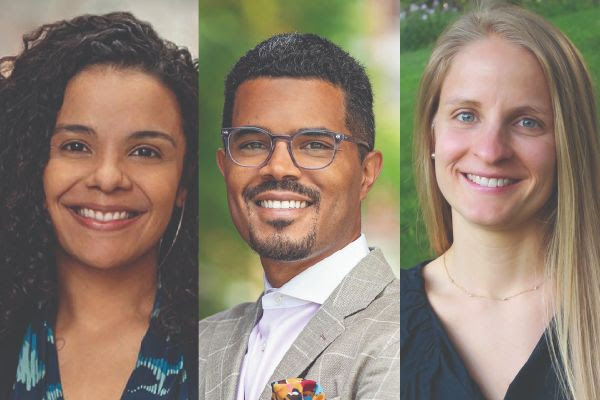
Awilda Rodriguez, Associate Professor of Education, is an associate professor in the Center for the Study of Higher and Postsecondary Education. Her research is at the intersection of higher education policy, college access and choice, and the representation of Black, Latino, low-income and first-generation students in postsecondary education.
Dr. Charles H.F. Davis III, Assistant Professor of Education, is an assistant professor in the Center for the Study of Higher and Postsecondary Education. His current research and teaching broadly focus on issues race and racism, systems of oppression, and structures of domination in U.S. higher education and its social contexts.
KC Deane, Predoctoral Research Fellow, EPI, is a doctoral candidate at the Center for the Study of Higher and Postsecondary Education and an IES predoctoral fellow at the University of Michigan. Her research focuses on institutional improvement at broad-access two- and four-year colleges, the intersection of city planning and college access for place-bound students, and state and federal higher education policy.