



The value of coaching and leadership in engineering
Education for Empowerment Minor James Riley Oosterhouse learns to lead from any position.

“I want to be a people-centered engineer,” says James Riley Oosterhouse, a rising junior in the College of Engineering, where he studies robotics engineering. To complement his technical skills, and to make him a more well-rounded engineer, Oosterhouse chose to take the Education for Empowerment Minor at the Marsal School. “When I start my job in industry, I want to be able to lead teams effectively. To help people grow to be the best people they can be, including myself.”
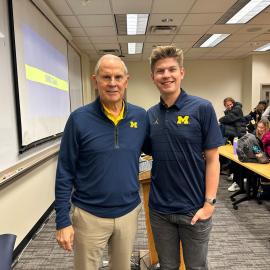
As a first-semester freshman, he took Education 240: Coaching as Leading. “I walked in and I didn’t know what had hit me. It was just so incredible.” Through a series of readings, guest speakers, lectures, and small group interactions, the course helps students grow in their understanding of the keys to becoming an effective leader and coach. Memorable guest speakers opened Oosterhouse’s eyes to the many facets of leadership. He learned about servant leadership from Ron Alvesteffer, CEO of Service Express. Phil Martelli, who was U-M associate head coach for basketball at the time, talked about respect. Law professor Barbara L. McQuade, the former US attorney for the Eastern District of Michigan, impressed the importance of communication in leading organizations.
Ultimately, Oosterhouse chose to pursue the Coaching and Leadership pathway within the minor, which provides students with the opportunity to explore leadership and its application in athletics while comprehending contemporary strategies for today's society and harnessing the transformative potential to drive social change.
“At Michigan we’re called the leaders and best. You can be the best engineer in the world, but you need to be able to lead people, too, if you want to be successful,” says Oosterhouse. “I think that the coaching and leadership pathway really empowers students to lead. It meets you where you’re at, and takes you farther.”
In addition to coursework determined by their respective pathway, each student in the minor completes the Education for Empowerment Internship with the goal of gaining practical field experience in education work. Oosterhouse interned with Marsal School lecturer Greg Dooley in a project management capacity. He helped to lead Dooley’s Name, Image, and Likeness (NIL) class which managed an NIL deal with six different athletes over the course of a school year. He got first-hand experience preparing contracts, designing merchandise, working with the apparel vendor Underground Printing, and navigating relationships with college athletes.
“You don’t have to be this huge voice that is dominating everybody to be a good leader,” says Oosterhouse. “There are different kinds of leaders. You can have influential leaders, you can have dominant leaders, you can also have passive leaders that bring an underlying tone of good energy. That level of respect for other types of leadership is what I gained from the minor. It has already impacted me, and will continue to.”
As a senior, Oosterhouse will complete the minor’s capstone project, but the coaching and leading skills he has gained are already paying off as he completes his degree in engineering.
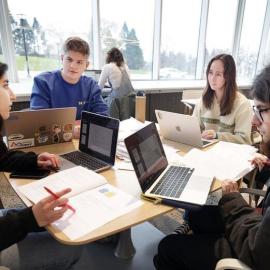
“The College of Engineering uses a team-focused approach to learning. We troubleshoot and debunk problems in teams. The ability to understand how to harness each person on the team’s unique attributes is what I took away from the minor. I’m not going to be the one that’s going to do all the work, or that can be the best at everything. But unlocking each individual’s skill in our group of four allows us to meet insurmountable challenges.”