



Mentorship paves the way
Victoria Vezaldenos honed her research skills in the ES master’s degree program in preparation for success as a PhD student who explores educational experiences of Multiracial youth.

When she first applied to the Marsal School to pursue her PhD, Victoria Vezaldenos had a clear vision of what she wanted to study, but she’d had little exposure to research labs as an undergraduate.
“I didn’t even know that experience was something you would need to get into a PhD program,” says Vezaldenos. She was referred instead to the master’s program in Educational Studies, and was awarded a prestigious Rackham Merit Fellowship to cover the cost of the degree plus provide a living stipend for the one year program.

Vezaldenos’ research focus is born out of her own experience being the daughter of a Mexican mother and a white father, as well as a first generation college student who struggled with the transition from high school to life as an undergrad at UCLA. She started out studying engineering—she had excelled in math at her small town high school. “Then I got to UCLA, and I was not the best anymore,” she says. It wasn’t until she decided to add a minor in education that she began to learn about the systemic issues that affect educational achievement. “It was interesting to unpack that it wasn’t that I was incapable, it’s that I hadn’t been given the resources to succeed—it was a systemic issue that caused me to struggle.” With this understanding, Vezaldenos became interested in studying equity in education.
“I left undergrad having read all these studies in education about how youth of color are underperforming compared to white youth, but what did that mean for me? I am both white and I am Mexican. The statistics and the data just don’t represent that lived experience.” She wanted to more deeply explore that question in graduate school.
Part of the Rackham Merit Fellowship included a visit to campus before Vezaldenos accepted the offer from the University of Michigan. She was introduced to Dr. Deborah Rivas-Drake, whose research on race aligned with her own interests. Vezaldenos decided to use the Program Evaluation and Improvement Research concentration in the Ed Studies master’s as an opportunity to prepare for applying to doctoral programs again. As a master’s student, Rivas-Drake became a mentor, along with Dr. Matthew Diemer, who studies critical consciousness, and who served as Vezaldenos’s academic advisor.
“I was able to really embed myself in their labs, where I gained an understanding of their data and their research,” says Vezaldenos. She also took a number of research methods classes. “I knew that would prepare me for the PhD, but I also knew that if I didn’t get in it would be advantageous to know how to use stats programs and do data analysis.”
Although the master’s program was meant to last one year, she received funding for a second year so that she could gain more research experience. Rivas-Drake and Diemer were instrumental in her PhD application process. “I think that alignment really helped me write a better statement when I applied to PhD programs. Their mentorship also gave me a better understanding of what I should be looking for in a doctoral program at Michigan—or elsewhere—and how to articulate my interest a bit more clearly.”
The second time around, Vezaldenos was accepted to the Marsal School’s Combined Program in Education and Psychology. Rivas-Drake and Diemer now serve on her dissertation committee.
“I study Multiracial youth, looking at how young people who are mixed race learn about race and racism and make sense of what that means to them,” says Vezaldenos. “The goal of my dissertation is to create a new measure or survey for Multiracial youth that helps researchers better understand the way that they’re thinking of these constructs.”
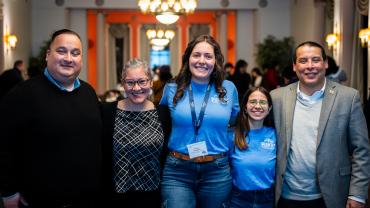
At Michigan, Vezaldenos has also been active in student life, helping to make students feel welcome at the large, and often intimidating, institution. She became a co-founder of Puentes, an organization for Latine graduate students, and co-chair of the Latino Psych Student Association. She also served on the Rackham Student Advisory Board. “Being engaged in student life and student involvement is a core value of who I am,” she says.
With most of her research now complete, Vezaldenos is focusing her time on writing. She plans to defend her dissertation in spring 2027.