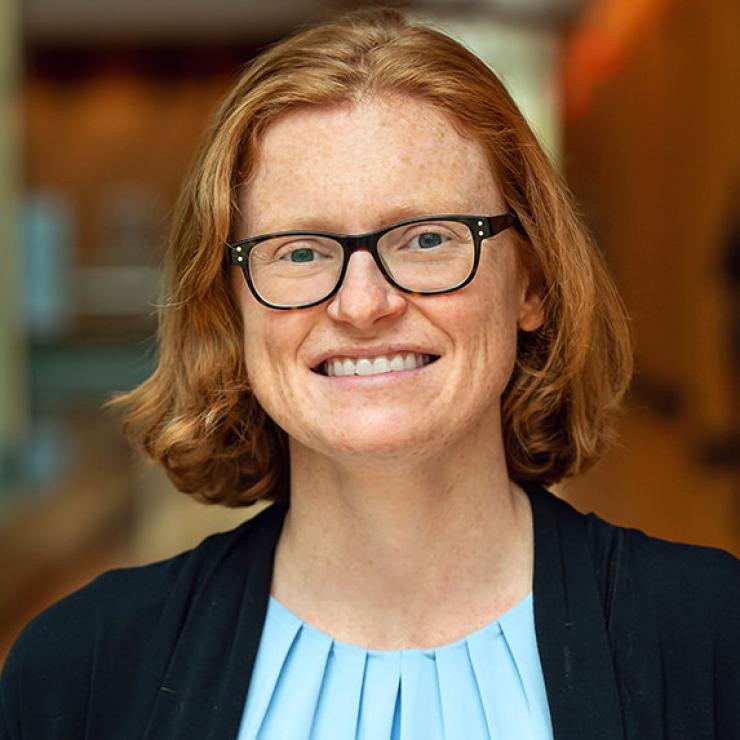



Christina Weiland and U-M graduate students Jonas Xie and Tiffany Wu develop a school closing tracker to put data about the closures into the hands of communities and policymakers
West Virginia has been hit with a wave of school closures and consolidations.

Expert Q&A
For Christina Weiland, an education and public policy professor at the University of Michigan who also co-directs the Education Policy Initiative, the matter is personal: The K-8 school she attended has shut its doors.
It's also driving her professionally: With University of Michigan graduate students Jonas Xie and Tiffany Wu, she developed a school closing tracker to put data about the closures more readily into the hands of policymakers, community members and families.
Good data, Weiland says, is key to evidence-based policymaking and her goal is to make it easier for data to inform debates about solutions in her home state and beyond, as it's a challenge facing many communities nationally. She discusses her efforts and where the work may go from here.
Tell me about the tracker and how it came to be.
The tracker is meant to be a tool for informing ongoing discussions and decisions about school consolidations in West Virginia. All these data are publicly available, but they weren't in an easy-to-use format that shows patterns in closures over the last 15 years.
We are working on a broader research study on the impacts of the closures. But in the meantime, we wanted to make an easy-to-use tool to put data more readily in the hands of policymakers, community members and families.
Our tool shows that 139 schools in the state have been closed in the last 15 years, which represents about 20% of West Virginia public schools that were open in 2011. The research shows 71% of closures were in schools with elementary grade students, and 62% of counties have closed at least one school.
These are big changes to small communities. Debate in the state about solutions is ongoing and we hope our tracker can inform discussions.
How does the closure of public schools in West Virginia compare to other states?
West Virginia isn't alone in its school closures wave. Nationally, many districts—particularly rural and urban communities—are closing schools due to a combination of enrollment drops, financial problems as pandemic funds expired, and the challenges of aging buildings. These are not easy problems to solve anywhere and are likely to get worse as birth rates drop across the country.
What do you hope to achieve or accomplish with the tracker? What would you like to see policy folks do with the information you provide?
Our aim is simple: We wanted to make an easy-to-use tool to help inform discussions about policy solutions to school closures and consolidations in the state. More kids and communities are likely to lose their local public schools in the coming years, unless action is taken.
The West Virginia State Legislature considered a range of bills focused on the closures in their last session, but none broke through. RAND, a nonprofit, nonpartisan research organization, also presented recommendations for improving the state's approach to funding public schools, but these, too, were not enacted.
The tool doesn't make recommendations on how to fix the problem; rather, it illustrates what the trends are overall, in each county and by school type. Good data are key to evidence-based policymaking, and our goal is to make it easier for data to inform debates about solutions.
I understand you have a personal connection to this project. Can you provide some detail about that and how it informs your work?
Unfortunately, my own alma mater, Geary Elementary and Middle School, is part of the latest wave of school closures in the state. Because of the closures, even the youngest children from the area will be facing commutes to school of well over two hours per day.
Buses will no longer stop at some of the same homes they have served for generations, leaving many families scrambling to get their children to and from school.
As a team, we are concerned the closures will move children from more rural places—from communities that often have fewer resources and higher poverty—further from opportunity.
Weiland is a professor of education at U-M's Marsal Family School of Education and the Karl and Martha Kohn Professor of Social Policy at the Ford School of Public Policy. Xie finished a master's degree at Marsal Education, where she will soon start a PhD program. Wu, who finished a PhD at Marsal Education, will be a postdoctoral researcher at Carnegie Mellon University and then an assistant professor at Marsal Education next year.
This article was originally published by Jeff Karoub for U-M News.